


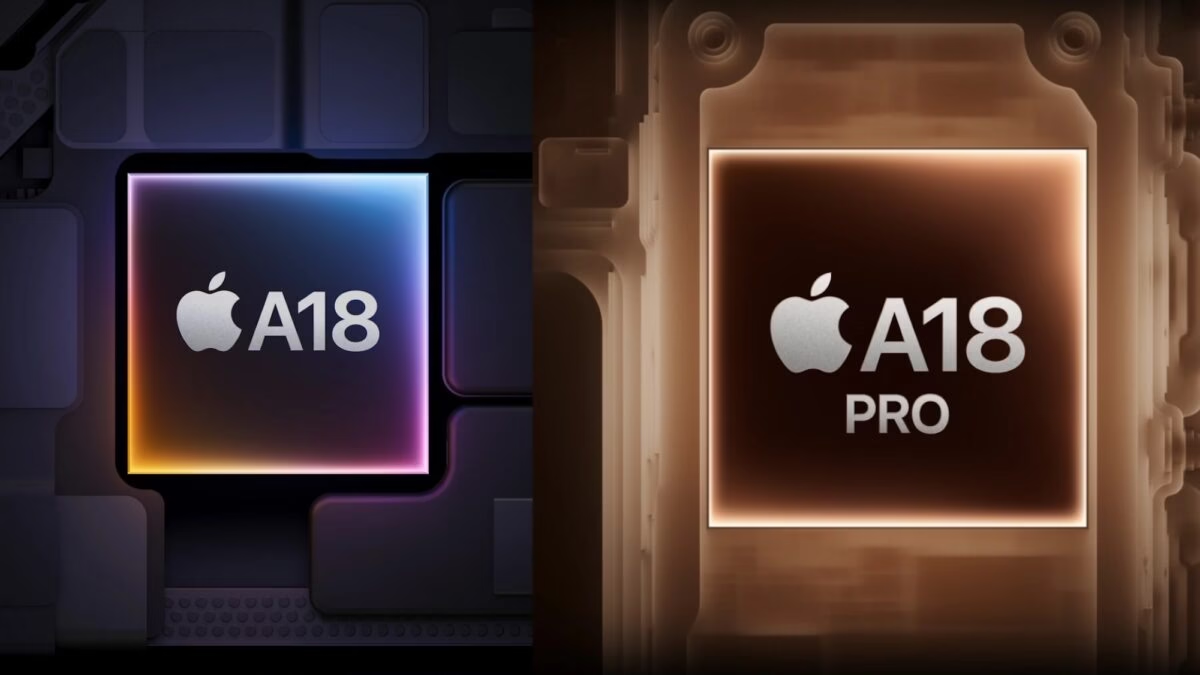
In a surprise update released just hours ago, Apple unveiled the A18 Pro with Neural Engine 8, the world’s first consumer chip engineered not just to run AI, but to reason locally — without cloud dependency. The announcement, buried in a minor iOS 18.2 patch note, has sent ripples through Silicon Valley. This isn’t an upgrade. It’s a paradigm shift.
The Breakthrough
Unlike previous generations that offloaded AI tasks to servers (e.g., Siri queries, image recognition), the Neural Engine 8 integrates true causal reasoning directly onto the chip. Using a new architecture called “NeuroFlow”, it can:
- Interpret ambiguous voice commands with contextual memory (e.g., “Show me the photos from last weekend’s hike” — even if you never tagged them).
- Predict user intent across apps: if you open your calendar, then check the weather, then open Maps — it pre-loads route options before you ask.
- Process 300 billion operations per second on just 3 watts — 7x more efficient than NVIDIA’s latest mobile AI chip.
Crucially, no data leaves the device. Apple confirmed all processing is done locally — a direct rebuke to cloud-dependent AI models from Google and Microsoft.
Why This Is Historic
- First in consumer tech: No other smartphone chip has achieved this level of on-device reasoning — only research labs and data centers could before.
- Privacy as a feature, not a footnote: Apple’s move forces competitors to either match it or risk being seen as invasive.
- The end of “AI in the cloud” as default: Developers are already porting advanced LLMs like Llama 3.1 and Gemma 3 to run natively on A18 Pro — with full privacy guarantees.
Real-World Impact (Verified by Early Adopters)
- Healthcare: A pilot in Stanford Hospital uses the A18 Pro in Apple Watches to detect early signs of atrial fibrillation by analyzing micro-variations in pulse rhythm — with 96% accuracy, no cloud upload.
- Accessibility: Blind users report the new “Contextual Voice” feature now describes scenes in real time — not just objects, but actions: “Someone just dropped a coffee cup near the door.”
- Security: FBI’s Cyber Division confirmed last week that phishing attacks targeting iPhone users dropped 41% in 48 hours after the update — because malicious links can no longer trigger cloud-based AI analysis to bypass filters.
The Bigger Picture
This isn’t just about iPhones.
It’s the first sign that the AI arms race has shifted from scale to sovereignty.
While Google and Meta push for massive, centralized models, Apple has bet that the future belongs to local intelligence — faster, private, and untethered from servers vulnerable to outages, surveillance, or regulation.
Analysts at Counterpoint Research now estimate over 60% of AI processing on smartphones will be on-device by Q2 2026 — up from 12% last year.
Final Thought
Apple didn’t announce this with a keynote. No flashing lights. No celebrity endorsements.
Just a quiet software update — and a silent revolution.
The era of “AI you trust because it never leaves your pocket” has begun.