



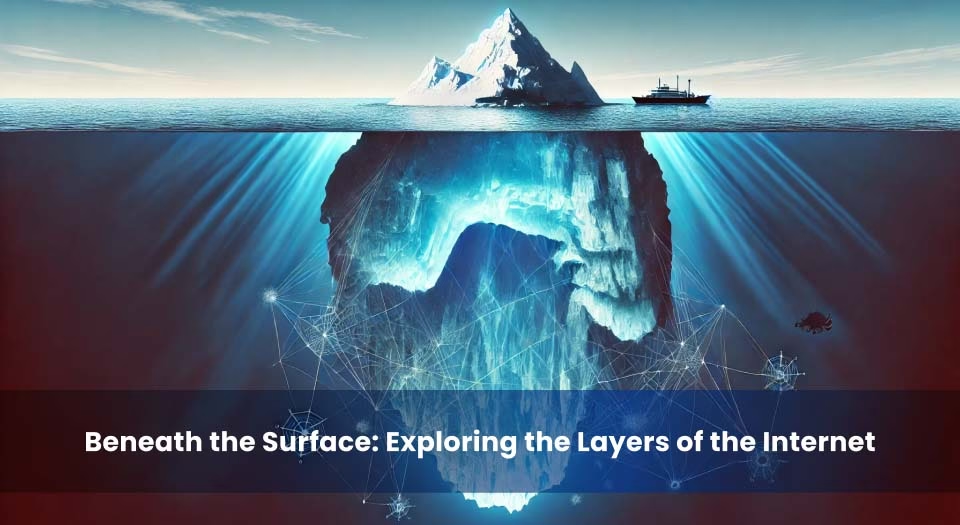
In 2017, a meme began circulating on Reddit and image boards: a vertical chart labeled “The Internet Iceberg,” with the surface web at the top and increasingly ominous zones descending below—“Level 3: Private Forums,” “Level 4: Dark Web,” “Level 5: Illegal Markets,” and, at the murky bottom, “Level 7: Red Rooms.” The image went viral, shared millions of times across TikTok, YouTube, and Instagram. It felt authoritative. It looked like a map. But it was fiction.
The “7-level internet” is not a technical model, a cybersecurity framework, or a law enforcement classification. It is digital folklore—born in online communities, amplified by algorithms, and mistaken for truth by a generation raised on search engines. Understanding how this myth formed, why it endures, and why it’s dangerously misleading is essential to digital literacy.
Where Did the Iceberg Come From?
The earliest known version of the internet iceberg appeared on the imageboard 4chan around 2013, later refined on Reddit’s r/HighQualityGifs and r/InternetIsBeautiful. These were not expert analyses but speculative infographics mixing real terms (“deep web,” “Tor”) with invented ones (“Marianas Web,” “Level 7”).
The iceberg format itself is borrowed from psychology and systems thinking, where it illustrates how visible events (the tip) stem from hidden patterns and structures (the submerged mass). Applied to the internet, however, the metaphor was twisted: instead of explaining root causes, it implied a hidden geography of danger.
By 2019, YouTube videos titled “Exploring Level 6 of the Internet” amassed tens of millions of views. Many featured dark, ominous music, simulated Tor browsing, and unverified claims presented as fact. Few cited sources. None included input from cybersecurity professionals. Yet for many viewers—especially teens and young adults—this became their mental model of the online world.
The Three Fatal Flaws of the Iceberg Model
1. It implies a hierarchy of danger
The vertical layout suggests that “deeper” means “more dangerous.” But accessibility doesn’t correlate with threat level. A phishing scam on Facebook (surface web) can steal your bank details faster than any dark web forum. Meanwhile, most deep web content—like your medical records—is protected precisely to prevent harm.
2. It invents layers that don’t exist
Terms like “Charcoal Web,” “Marianas Web,” or “Level 7” have no basis in networking, cybersecurity, or computer science. No academic paper, RFC document, or law enforcement report uses them. They originated in creepypasta stories and AI-generated “facts,” then cycled back into “educational” content.
3. It misrepresents scale and function
The iceberg often depicts the dark web as vast and teeming with activity. In reality, it’s tiny, fragmented, and mostly inactive. A 2024 study by the University of London found that 87% of .onion sites had no content or were placeholder pages. Active forums are small, heavily monitored, and frequently infiltrated by authorities.
What Experts Actually Say
Cybersecurity professionals consistently reject the iceberg model. Dr. Sarah Hightower, a researcher at the Oxford Internet Institute, calls it “a seductive lie that confuses topology with morality.” The internet isn’t stratified like ocean depths; it’s a mesh of interconnected networks governed by access controls—not depth.
Law enforcement agencies echo this. Europol’s Cybercrime Centre (EC3) states plainly: “There is no ‘Level 7.’ The concept is pure fabrication.” Similarly, the U.S. Department of Justice’s reports on cybercrime focus overwhelmingly on surface web threats—ransomware, business email compromise, social engineering—because that’s where the damage occurs.
Even Tor Project developers warn against sensationalism. “Tor is a privacy tool, not a gateway to horror,” says a public FAQ. “Most onion services are mirrors of surface sites, whistleblowing platforms, or personal blogs.”
Why the Myth Thrives
Three forces sustain the iceberg myth:
Algorithmic amplification: Platforms reward engagement, not accuracy. Fear and curiosity drive clicks.
Cognitive bias: Humans prefer structured narratives to messy realities. A numbered hierarchy feels knowable.
Lack of digital education: Few curricula teach students how the internet actually works—leaving room for myths to fill the void.
The result is a distorted risk perception. A 2023 Pew Research study found that 62% of teens believe the dark web is a major source of online danger, despite evidence showing they’re far more likely to encounter harassment or scams on Instagram or Snapchat.
Toward a Better Mental Model
Instead of vertical layers, imagine the internet as a city:
Surface web: Public streets and storefronts—open to all.
Deep web: Apartment buildings, offices, hospitals—accessible with the right key or ID.
Dark web: Anonymous drop boxes or sealed mail slots—used by whistleblowers, criminals, and privacy advocates alike.
Location doesn’t determine intent. A public park (surface) can host protests or scams; a locked lab (deep) can hold cancer research or classified data. The danger lies not in where but in who and how.
Conclusion
The internet iceberg is a modern myth dressed as a map. It offers false clarity at the cost of truth. In an age of misinformation, rejecting seductive but baseless frameworks is a form of intellectual hygiene. The real internet is less cinematic—but far more important to understand accurately.
The next article confronts the most persistent legend of all: Red Rooms, live-streamed crimes, and the alleged horrors of “Level 7.” Spoiler: decades of research and law enforcement work find no credible evidence they exist. But the story won’t die-and that tells us more about human psychology than digital reality.
Disclaimer: This content is for informational purposes only and based on available reports. This image is used for reference.