


While governments worldwide scramble to curb the soaring energy appetite of AI and cloud computing, Finland has taken a radically different approach: instead of treating data centers as climate liabilities, it is integrating them directly into its national heating ecosystem.
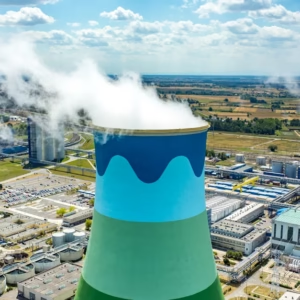
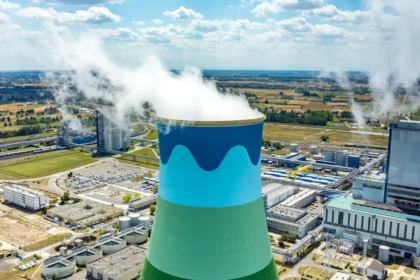
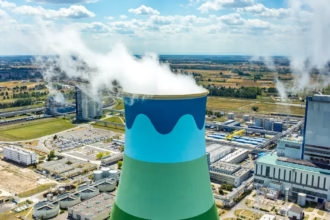
Across the Helsinki metropolitan area — including Espoo, Helsinki, and surrounding municipalities — waste heat from data centers is now being captured and fed into district-heating networks that warm homes, schools, and hospitals. What used to be expelled into the air through cooling towers is becoming a renewable-grade heat source.
This isn’t recycling. It’s industrial symbiosis at scale.
How It Works
Data centers generate vast amounts of low-grade heat. Traditionally, this heat is dissipated into the air or nearby waterways. Finland flips the model.
Through partnerships involving companies such as Microsoft, Google, Equinix, and local utilities including Fortum and Helen Oy, data-center cooling loops are connected to district-heating grids — a network of insulated underground pipes that supply hot water to buildings throughout the year.
Here’s how the system operates in practice:
- Warm water from data-center cooling systems is routed into the district-heating network.
- Large industrial heat pumps elevate the temperature to levels suitable for winter delivery.
- During warmer months, excess heat can be stored in thermal reservoirs, such as underground rock caverns — a storage technology Finland already uses at scale.
- Much of the integration leverages existing district-heating infrastructure, reducing the need for costly new construction.
The result is a continuous, stable supply of carbon-free heat that can displace fossil-fuel-based generation.
Why Finland?
Several factors make Finland a global front-runner:
Cold climate: Nordic temperatures naturally reduce cooling costs for data centers, increasing the efficiency of heat capture.
Extensive district heating: In Helsinki, most buildings are already connected to district-heating systems, making it easy to route heat where it’s needed.
Policy alignment: Finland’s national strategies for data-center development and clean heat strongly encourage — and in many cases require — that large new facilities evaluate heat-reuse potential during project design.
Together, these conditions create an environment where waste-heat utilization isn’t a niche experiment — it’s expected.
Real-World Impact
Several major projects are already operating or under construction:
Microsoft & Fortum — Espoo / Kirkkonummi
Microsoft’s upcoming data-center region in the Helsinki area will connect to Fortum’s district-heating network. The companies say the project will replace a significant share of local fossil-based heat generation once fully operational — one of the largest data-center heat-recovery initiatives in the world.
Google — Hamina
Google’s data center in Hamina is integrating heat recovery with the local utility, with the potential to supply a substantial portion of district-heating demand in the area. The facility’s location near existing infrastructure makes it a flagship example of how tech companies can mesh with municipal energy systems.
Equinix & Helen
Colocation operators are also participating, with several facilities in the Helsinki region delivering captured heat back into urban grids.
The economic case is strong: data-center operators can earn revenue by selling recovered heat, while residents benefit from more stable and increasingly low-carbon heating.
A Model for the World
Finland’s model is drawing global attention. Cities such as Stockholm and Amsterdam are expanding their own heat-recovery programs, and several U.S. municipalities are exploring pilot projects with major cloud providers. The International Energy Agency has highlighted heat recovery as a key strategy in data-center decarbonization, calling it one of the most effective ways to reduce the sector’s growing climate footprint.
As energy systems shift from centralized generation to integrated, circular networks, Finland’s approach offers a blueprint: treat digital infrastructure not just as an energy consumer, but as an energy resource.
Challenges Ahead
Not every city can replicate Finland’s model immediately. Barriers include:
- Limited district-heating infrastructure, especially in countries dominated by individual home heating.
- Regulatory frameworks that were not designed for two-way heat markets.
- Seasonal mismatches between heat supply and demand — requiring investment in storage or flexible system design.
Still, Finland is actively sharing technical guidelines, integration frameworks, and policy templates to accelerate adoption abroad.
Final Thought
For decades, data centers lived behind fences — silent, power-hungry black boxes.
Finland has pulled them into the heart of the city, weaving digital infrastructure directly into the urban energy system.
In doing so, it offers a clear lesson:
True sustainability isn’t about using less — it’s about wasting nothing.